Last summer, we explored The Digital Expansion Gauntlet, highlighting how growing UK businesses face real constraints: talent, budget, and time.
Success comes not from moving faster, but from gaining leverage: the right partnerships, the right priorities, and the right decisions made at the right time. Today, there’s a new dimension to that challenge: Artificial Intelligence.
If your business is expanding and navigating growth, AI may feel like something you should be addressing — but aren’t quite sure where to start.
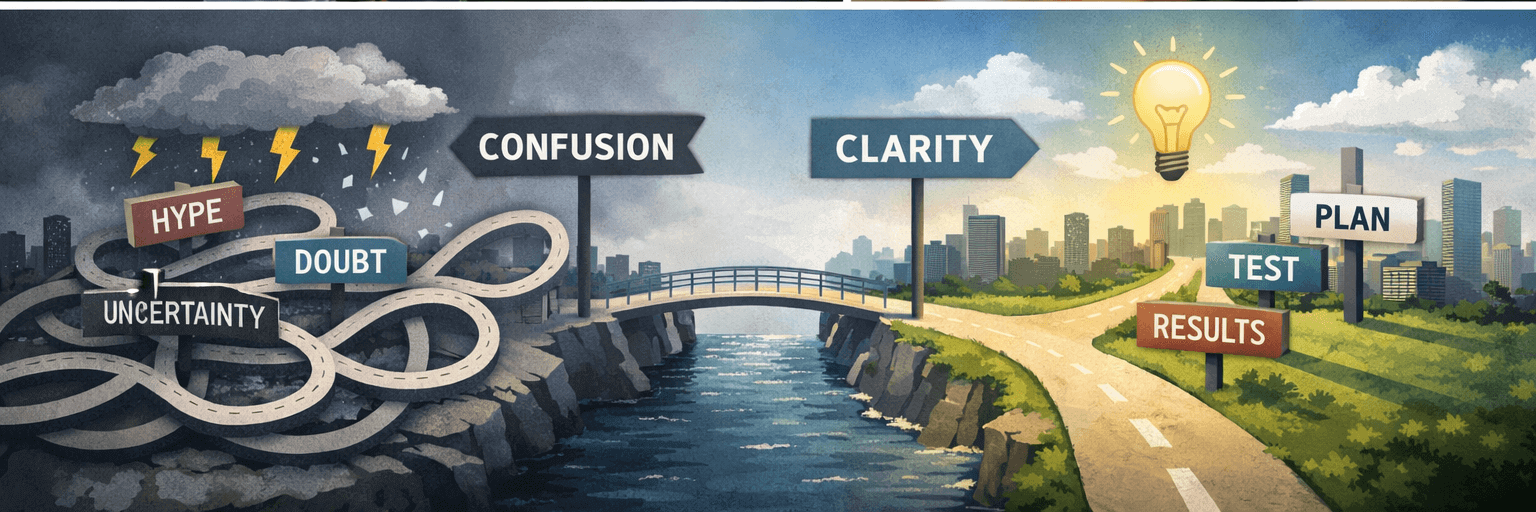
Everywhere you look there’s noise:
- One article says AI will transform your business overnight.
- Another warns of risk, compliance headaches, and reputational damage.
- Vendors promise magic solutions.
- And you’re left running the business you already have, trying to do more with the resources you actually have.
If that sounds familiar, you’re not behind — you’re being thoughtful.
At Maverick Partners, we see this hesitation not as resistance, but as a signal that your leadership is trying to make good decisions in a world full of hype. The fear around AI isn’t irrational — it’s a natural response to blurry choices, conflicting advice, and a fast-moving landscape.
The good news? You don’t need every answer today. And you definitely don’t need to bet the business on AI.
Why AI Feels So Risky for Growing Organisations
Large enterprises can experiment freely. Start-ups can move fast and take risks. Expanding organisations often sit in the middle.
You’re big enough that:
- Inefficient processes hurt
- Manual work doesn’t scale
- Customers expect more
But not so big that:
- You can waste money on the wrong technology
- You have in-house AI specialists
- You can absorb public mistakes
So when people say “just start using AI”, it’s rarely helpful. The real anxiety usually comes down to a few human concerns:
- What if we choose the wrong platform?
- What if we lock ourselves into something that doesn’t fit?
- What if this creates risk we don’t fully understand?
- What if everyone else is already ahead of us?
These aren’t technology problems. They’re decision problems.
The Biggest Myth: You Need an AI Strategy
One of the most unhelpful ideas we encounter is that businesses need a fully formed AI strategy before taking any action.
In reality, what matters far more is having clarity on:
- Where time, money, or quality is being lost
- Which decisions really matter over the next 6–12 months
- What good would actually look like for your organisation
AI should support your business strategy — not become one of its own.
For expanding organisations, progress starts not with a grand transformation, but with one or two well-chosen, well-understood problems.
Where AI Actually Adds Value (Today)
When you strip away the hype, AI is particularly effective at a small number of things:
- Reducing repetitive, manual effort
- Surfacing patterns in data
- Supporting faster, better-informed decisions
- Improving consistency at scale
That’s why the most successful early use cases tend to be practical rather than flashy:
- Management reporting and insight
- Customer enquiries and triage
- Marketing and content workflows
- Sales administration and CRM hygiene
- Operational planning and forecasting
These aren’t about replacing people. They’re about removing friction so teams can focus on work that actually drives growth.
Making Sensible Technology Choices Without the Sales Pressure
One of the biggest challenges for growing organisations is navigating a crowded technology landscape where every solution claims to be the answer.
This is where independence matters.
Rather than starting with a product, the smartest organisations start with perspective: an objective view of what’s available, what’s proven, and what’s appropriate for their size, sector, and ambitions.
Working with an experienced partner who understands both the technology and the commercial reality allows leaders to:
- Compare options without bias
- Pressure-test vendor claims
- Leverage proven platforms rather than untested promises
- Make decisions based on fit, not fashion
Strong relationships across the technology ecosystem mean better visibility, better choices, and fewer expensive missteps.
A Practical Way to Approach AI Decisions
We often encourage organisations to think in stages:
1. Start with outcomes, not tools
What would genuinely move the business forward? Faster turnaround? Better visibility? Reduced admin burden?
2. Test before you commit
Short pilots. Clear success measures. Minimal disruption.
3. Keep people at the centre
AI should support judgement, not replace it — particularly in early phases.
4. Preserve flexibility
The technology is evolving quickly. Avoid decisions that limit future options.
This approach doesn’t just reduce risk — it builds confidence, capability, and momentum.
The Real Risk Isn’t Getting It Wrong — It’s Standing Still
While panic is unnecessary, complete inaction isn’t neutral.
Over time, organisations that apply AI thoughtfully will:
- Operate more efficiently
- Respond faster to customers
- Make better use of their data
- Free up teams to focus on higher-value work
The danger isn’t choosing the wrong tool. It’s delaying decisions until they’re forced by circumstance.
Calm, Clarity and Confidence
AI doesn’t replace leadership — it reveals it.
The organisations that succeed won’t be the ones chasing every new platform. They’ll be the ones making calm, informed decisions with a clear line of sight to business value.
That’s where having a trusted, independent partner makes the difference: someone focused on outcomes, not agendas; on fit, not hype.
If you’re uncertain where to start, that uncertainty is often the most valuable starting point of all.