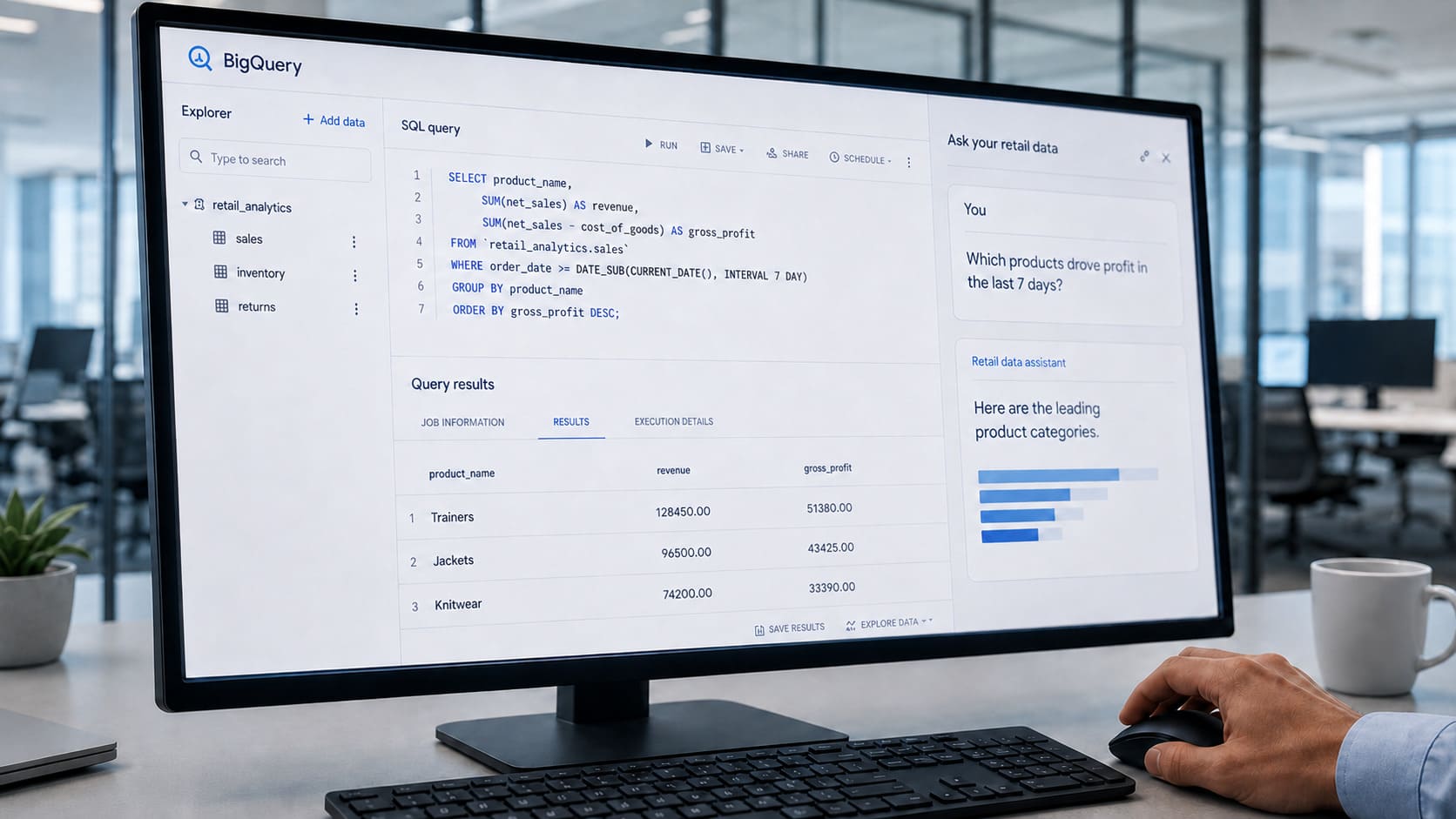
Retailers are not short of data. Sales, margin, product, customer, stock, campaign and returns information is being collected across almost every part of the business.
Much of it is already sitting in BigQuery.
Yet the route from data to decision is often slower than it should be. Business teams search through dashboards, export information into spreadsheets or submit another request to an already busy analytics team. A question that takes seconds to ask can still take days to answer.
A commercial director wants to know why margin fell last week. A trading team wants to understand which categories are driving a rise in returns. A supply chain lead wants to see where stock-outs are suppressing sales.
The answers may already exist. The difficulty is accessing them quickly, confidently and in a form that helps someone decide what to do next.
Dashboards Answer Known Questions
Dashboards remain an important part of the retail data estate. They provide a consistent view of agreed measures and help teams monitor performance over time.
But dashboards are designed around questions someone anticipated in advance. When the question changes, users often need a new filter, another report or help from somebody who can write SQL and understand the underlying data model.

The standard BigQuery interface
This creates a gap between the people making commercial decisions and the people able to interrogate the data. Analysts spend time responding to routine requests, while business users wait for answers that may be time-sensitive.
A conversational data agent provides another route. It does not replace the warehouse, dashboards or analytics team. It gives authorised users a simpler way to explore the data between those established reporting cycles.
What a Conversational Data Agent Changes
A conversational data agent allows someone to ask an ordinary business question and receive an answer grounded in the organisation’s own data.
Google’s Conversational Analytics in BigQuery is now generally available. It enables business and technical users to query data, conduct multi-step analysis and generate reports using natural language, directly where the data is held.
For a retailer, that could mean asking:
- Why did online revenue fall yesterday?
- Which products are selling well but contributing less margin?
- Where are stock-outs currently costing us the most revenue?
- Which promotions generated incremental sales rather than discounting existing demand?
- What is driving the increase in returns for this category?
These questions can lead naturally to follow-ups. A user can move from identifying a change, to understanding which products, channels or customer groups caused it, without starting a new report request each time.
The experience feels conversational, but the value does not come from the chat interface. It comes from connecting that conversation to governed data and giving the agent enough business context to interpret the question properly.
A Chat Interface Is Not the Same as a Trusted Answer
Connecting an AI model to a data warehouse is the easy part. Producing answers that people can trust is where the real work begins.
Retail language is full of definitions that appear simple but vary between businesses. Revenue might mean gross sales, recognised revenue or sales after cancellations. Margin may or may not include fulfilment costs. A return can be recorded when it is requested, received or refunded.
If those definitions are not clear, a technically correct query can still produce the wrong business answer.
BigQuery data agents can be configured with table and field metadata, business instructions and verified queries. This helps the agent understand the meaning of the data, select appropriate sources and handle important questions consistently.
A useful retail data agent therefore needs to:
- Use agreed definitions for measures such as revenue, margin, conversion and returns.
- Respect the existing permissions applied to commercially sensitive and customer data.
- Start with tested questions and verified queries for important use cases.
- Show the data and assumptions supporting its answer.
- Be tested with the people who will use the insight to make decisions.
Without this grounding, the result is an impressive demonstration. With it, the agent can become a dependable part of day-to-day retail decision-making.
How This Changes the Relationship Between Business and Data Teams
A conversational data agent should not be positioned as a replacement for analysts. Its more useful role is to handle the first stage of exploration and reduce the queue of routine questions.
Consider a user asking why online margin fell last week. The agent might first compare performance by category, then identify a rise in promotional sales within one category, and finally show that the affected products also carried higher fulfilment costs.
The analyst remains essential. They define trusted measures, investigate complex issues and improve the data model. But they no longer need to act as the only route between a business question and the underlying data.
That gives commercial teams greater independence while allowing data specialists to spend more time on the work that genuinely requires their expertise.

Start With One Decision, Not Every Dataset
The strongest starting point is not a general-purpose agent connected to everything. It is a bounded use case built around a decision that matters.
For many retailers, that could be a Retail Performance Agent covering orders, products, inventory, promotions and returns. Its first job might be to help trading and commercial teams understand daily changes in revenue and margin.
The initial scope should include a small set of high-value questions, the data needed to answer them and the definitions everyone agrees should be used. Answers can then be checked against existing reports and reviewed by analysts before the agent reaches a broader group.
Success should be measured in practical terms: how quickly users obtain an answer, how consistently it agrees with trusted reporting, whether people use it without support and whether it reduces repetitive requests to the data team.
Once that use case works, the agent can expand into areas such as stock performance, returns analysis, customer behaviour, promotion effectiveness and operational forecasting.
From Data Warehouse to Decision Tool
BigQuery may already be the central home for a retailer’s data. A conversational layer makes that investment more accessible to the people making decisions across the business.
The opportunity is not simply to let everybody ask anything. It is to create a governed route from a well-framed business question to an answer that is clear, traceable and useful.
Maverick Partners and our partner Aliz bring together retail use-case design, product thinking, Google Cloud engineering and data expertise. We’re helping organisations identify the right starting question, prepare the business context and build a working data agent around the systems they already use.
If your retail data is already in BigQuery, start with one question the business regularly waits too long to answer. Prove that an agent can answer it accurately, safely and repeatedly. Then expand.
Bring us that question, and we will help you map the required data, definitions and guardrails—and identify the quickest route to a focused pilot.