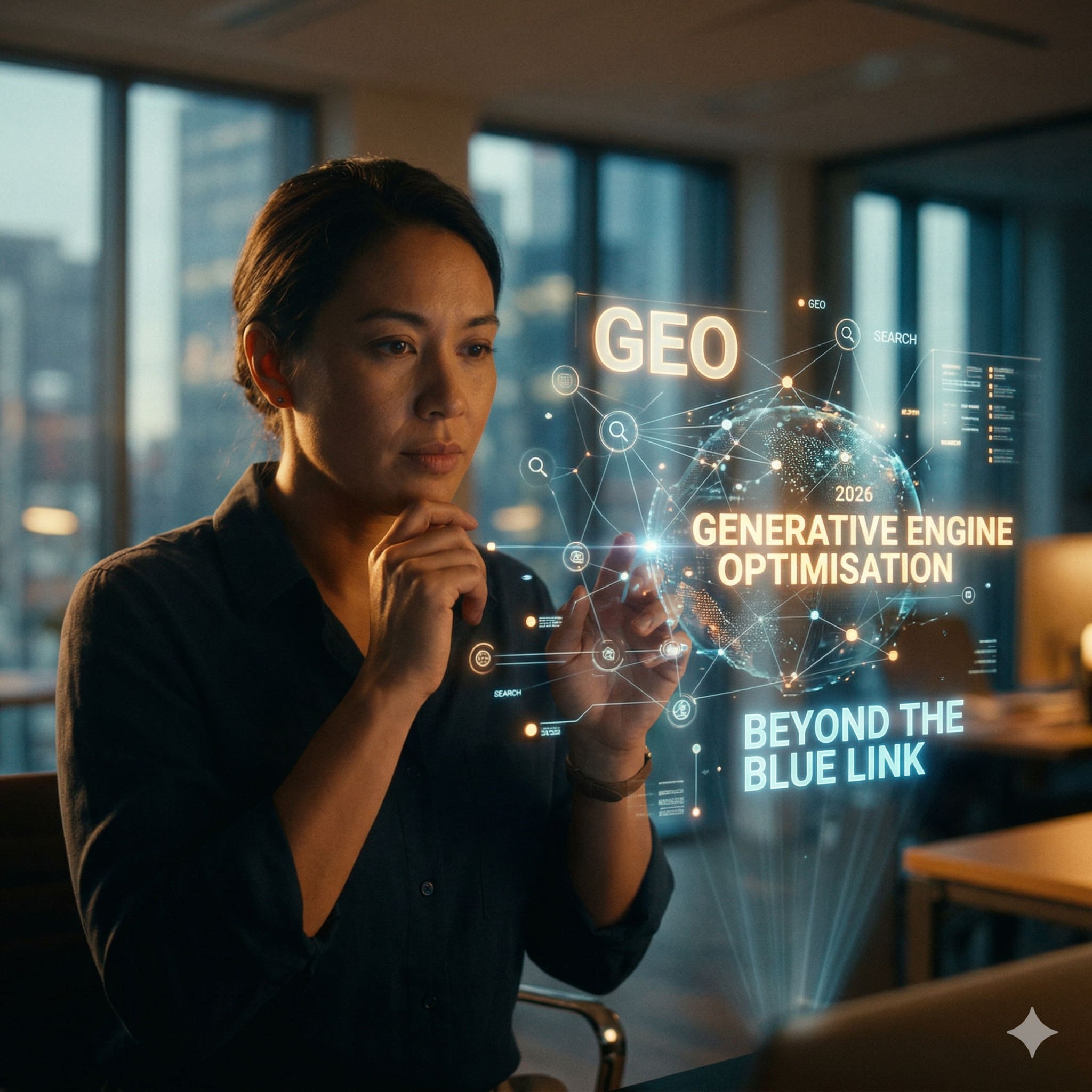
For over two decades, digital visibility meant one thing: rank on Google, win the click, get the traffic. That model is breaking down.
In 2026, your audience doesn’t type a query and scroll through ten blue links. They ask an AI agent a question and get a direct answer. We’ve moved from a Library Model, where you walk in and find the right book, to a Concierge Model, where an AI hands you exactly what you need. No browsing. No clicking. No visiting your website at all.
If you’re a CEO or Marketing Director watching your organic traffic decline quarter after quarter with no clear explanation, this is why. The traffic isn’t going to a competitor’s website. It’s not going to any website. It’s being absorbed by AI-generated responses from tools like ChatGPT, Gemini, and Perplexity.
This is where GEO comes in. Generative Engine Optimisation is the practice of structuring your content so that AI models cite your brand as the authority when answering questions in your space. Traditional SEO got you onto page one. GEO gets you into the answer itself.
The Zero-Click Reality: Why Brand Mentions Are the New Currency
When a decision-maker asks an AI assistant, “What’s the best approach to digital product strategy for mid-market companies?”, the AI doesn’t return a list of links. It returns a synthesised answer, sometimes citing sources, sometimes not.
Clicks to websites are decreasing because the AI answers the query directly within its interface.
This Zero-click environment is accelerating across every sector. The question is no longer “how many people visit our site?” but “how often does AI mention our brand when our audience asks questions?”
The old funnel – attract visitors, convert them on your site – still matters. But a new layer sits on top of it. Before anyone clicks, they ask an AI. And if you’re not in that answer, you never get the chance to convert.
Three Businesses Already Winning With GEO
GEO isn’t theoretical. Businesses across multiple industries are already seeing measurable, documented results.
Vercel: 10x Growth in ChatGPT Referrals
Vercel, a web deployment platform, provides the clearest case study in GEO success. Their results are stark and publicly verified: ChatGPT now drives approximately 10% of new Vercel signups—up from less than 1% just six months ago. That’s a 10x increase in half a year, driven entirely by AI search optimization.
How did they do it? Vercel restructured their developer documentation for AI readability. Clear documentation separated from JavaScript rendering (static HTML instead of client-side rendered content), structured information answering developer questions directly, and regular content updates signaled to AI systems that Vercel was the authoritative source for web deployment concepts. When developers ask ChatGPT “what’s the best way to deploy a web application?”, the AI consistently recommends Vercel. This consistency in citation drives their 10% milestone.
What’s notable: Vercel’s users already had high intent. But the visibility advantage compounds. Every citation in ChatGPT creates brand reinforcement for the next user who asks the same question.
SteelSeries: 23x AI Search Traffic Growth
Gaming accessory brand SteelSeries faced an unusual problem in late 2024: they were dominant in traditional search for gaming headsets and keyboards, but nearly invisible to AI recommendation systems. When gamers asked ChatGPT, Gemini, or Perplexity “what’s the best gaming headset?”, competitors were appearing instead.
SteelSeries implemented systematic Answer Engine Optimization strategy. They restructured product pages with question-based headers that mirror how gamers ask AI assistants, added structured data markup (schema) to ensure AI systems could parse product specifications, built topical authority content comparing products and answering specific gaming hardware questions, and maintained consistent, fresh product information across all pages.
The results: SteelSeries drove a 23x increase in year-over-year AI search traffic and a 75% improvement in Perplexity Visibility Score. They now dominate gaming accessories recommendations across AI platforms—a first-mover advantage that compounds as AI systems reinforce existing authoritative citations.
Tally: AI Search as Primary Growth Channel
Form builder Tally.so took a different approach. Instead of waiting for AI to discover them, they built systematic authority on Reddit, LinkedIn, and in community forums where AI systems pull training data. They published comparison guides (“Best form builders,” “Jotform alternatives”), answered questions authentically, and showed up consistently where their audience was already asking questions.
When GPT-4o launched with web browsing capabilities, all that community presence became visible to AI training data. The result: ChatGPT became Tally’s #1 referral source, contributing to their growth from $2M to $3M ARR in just 4 months. Over 2,000 new users per week now come from AI platforms—without any paid acquisition or growth hacks.
The GEO Strategy: Cite-ability, Sentiment, and Human Provenance
Winning at GEO comes down to three principles.
Cite-ability
AI models need content they can reference with confidence. That means writing with clear, specific, data-backed statements. Vague thought leadership doesn’t get cited. A sentence like “Companies that adopt structured data practices see a 34% improvement in AI citation rates” does.
Structure your content so AI can extract it. Use clear headings, direct answers to common questions, and original statistics. According to GEO research from LLMrefs, content with extractable structure and source data performs significantly better in AI search results than long-form narrative content.
Brand Sentiment
AI models don’t just crawl your website. They pull from across the web, LinkedIn articles, industry publications, review platforms and forum discussions. Your brand’s presence on these high-authority platforms feeds directly into how AI models assess your credibility.
If your executives are publishing on LinkedIn, if your firm is quoted in industry journals, if your brand appears consistently across trusted sources, AI models treat you as authoritative. This isn’t about vanity metrics. It’s about building the trust signals that AI systems use to decide who gets cited.
Human Provenance
Here’s the counterintuitive part. 100% AI-generated content actually hurts your GEO. AI models are increasingly trained to prioritise human-verified, human-authored data. As Mekaa’s 2026 GEO guide documents, content that demonstrates genuine human knowledge and original thinking outperforms AI-generated material in citation rankings.
Why? Because AI models trained on AI-generated content create a feedback loop of diminishing quality. The models know this. They’re built to prefer primary sources, original data, and content that carries markers of real human experience and authority.
The Merge of SEO and GEO
Traditional SEO and GEO are converging. Structured content, authoritative sourcing, regular updates, and technical readability matter for both. The difference is intent. SEO optimises for a search engine’s ranking algorithm.
GEO optimises for an AI model’s citation logic. The best content strategy in 2026 does both simultaneously.
What To Do Now: A Practical Starting Point for B2B Leaders
You don’t need to overhaul everything overnight. Start with four actions:
- Audit your content for AI readability. Go through your top-performing pages and ask: Does this content provide clear, direct answers? Does it include original data or specific statistics? Is it structured so that an AI model can extract and cite a clean statement? If the answer is no, you have a content gap.
- Shift your KPIs. Clicks and rankings still matter, but add AI brand mentions and citation frequency to your dashboard. Tools are emerging that track how often your brand appears in AI-generated responses. Start measuring what matters next, not just what mattered last year.
- Invest in original research. Proprietary data is the single most defensible asset in a GEO strategy. Commission industry reports. Run surveys. Publish findings that no one else has. AI models can’t ignore data that doesn’t exist anywhere else.
- Build authority on the platforms that feed AI. LinkedIn, industry journals, reputable publications. These aren’t just marketing channels anymore. They’re the inputs that AI models use to determine whether a source is trusted. A consistent, expert-led presence on these platforms directly influences whether your brand gets cited.
The Brands That Move First Will Own the AI Conversation
The competitive window for GEO is open right now, but it’s closing. AI citation authority compounds over time. Brands that establish themselves as trusted sources early gain a structural advantage that late movers will struggle to match.
The cost of inaction is straightforward: your brand becomes invisible to the fastest-growing search channel in business. Your audience is already asking AI agents for recommendations, analysis, and advice in your category. If you’re not in those answers, someone else is.