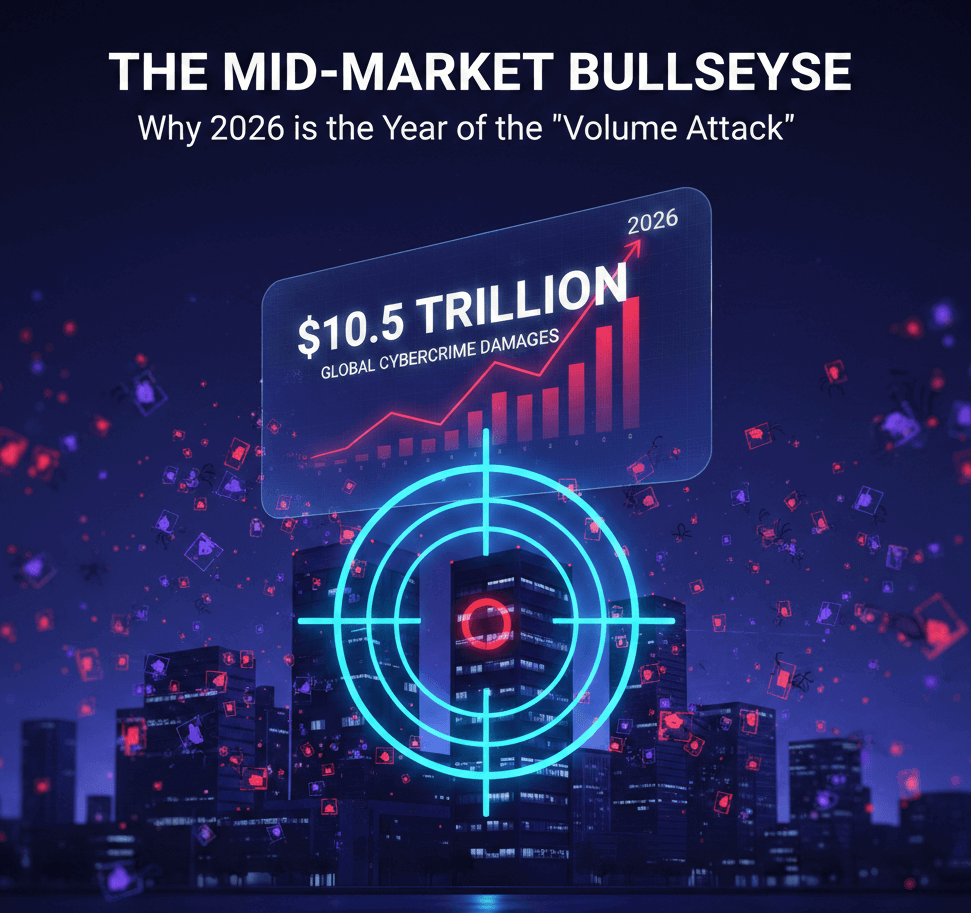
Cybercriminals are no longer chasing the “big fish.” Large enterprises, with AI-driven Security Operations Centres (SOCs), layered defences, and deep pockets, have become harder targets. Mid-market firms, however, now bear the brunt of attacks—and the cost of inaction has never been higher.
In 2024, 45% of medium-sized businesses reported experiencing cybercrime, and 60% now consider themselves likely targets. With global cybercrime damages projected to hit $10.5 trillion annually by 2026, mid-market organisations are effectively on the front line of a high-stakes digital war.
The Rise of the “Volume Attack”
A decade ago, launching a cyberattack required specialist skills and time. Today, Ransomware-as-a-Service (RaaS) and autonomous AI bots have changed the game.
For attackers, the maths is simple: why spend months probing a highly protected corporate network when automated attacks can strike hundreds of mid-market businesses at once? Volume now outweighs precision.
Take a mid-sized manufacturer supplying a FTSE 100 automotive firm. In late 2025, an AI-driven ransomware campaign infiltrated its patchwork of point-solution defences—firewall here, endpoint protection there—and brought production to a standstill within hours. A Tier-1 client temporarily suspended contracts, resulting in a revenue loss of £2.1 million, excluding long-term reputational damage.
The lesson is clear: mid-market firms are no longer “too small to matter.” They are lucrative, accessible targets.
The Silo Trap
Most mid-market firms rely on disconnected tools—email security here, endpoint protection there. These silos create blind spots that attackers exploit. Lateral movement often goes undetected for months, leaving sensitive data exposed and systems vulnerable.
A 300-person software vendor learned this the hard way in early 2026. Even without a breach of its own systems, failing a Tier-1 client’s updated cyber audit led to removal from their approved vendor list, with projected losses of £4.7 million. Fragmented security doesn’t just risk data—it risks strategic business relationships.
Supply Chain Risk: Weak Links Cost Millions
Mid-market firms are crucial nodes in global supply chains. They handle data, integrate systems, and process transactions for larger partners—making them attractive entry points for attackers.
The National Cyber Security Centre (NCSC) now mandates supply chain assurance at Board level. Vendor security is no longer a “nice-to-have”; it is a commercial necessity. Failing an audit can cost multi-million-pound contracts.
Consider a mid-market logistics company hit by ransomware, which paralysed operations for ten days. The ransom cost £120,000—but the total operational and reputational damage exceeded £1.2 million. Key clients switched to competitors, demonstrating that even temporary disruptions can have lasting consequences.
Regulatory and Insurance Pressures
The era of lax governance is over. Multi-state and international privacy laws now demand auditable compliance frameworks. Signed policies are no longer sufficient; boards must ensure that privacy and security are operational disciplines embedded across the organisation.
Cyber insurance is also tightening. Premiums are rising, coverage is narrowing, and insurers demand evidence of proactive controls and rapid incident response. Boards are personally accountable for cyber risk—ignorance is no defence.
A Unified Security Lifecycle: From Firefighting to Strategy
The solution isn’t “more tools.” It’s integrated, lifecycle-based security:
- Prevention: Harden perimeters and stop easy, automated attacks.
- Protection: Implement Zero Trust to limit the impact of breaches.
- Detection: Consolidate tools to gain visibility across cloud, endpoints, and identity systems.
- Response: Have rehearsed plans to restore operations in hours, not weeks.
Consolidating fragmented tools into unified platforms gives lean teams full visibility without adding operational overhead. Cybersecurity becomes business infrastructure, not just an IT function.
Cybersecurity as a Commercial Advantage
In 2026, security is not optional—it is a business requirement. Boards that embed cybersecurity into governance, vendor management, and operational planning will survive and thrive. Those that treat it as an afterthought risk regulatory fines, lost revenue, and irreparable reputational damage.
Mid-market firms that embrace a unified, lifecycle-based approach today will be the ones still standing when cybercriminals strike next. For them, cybersecurity is no longer a cost—it’s a competitive advantage.