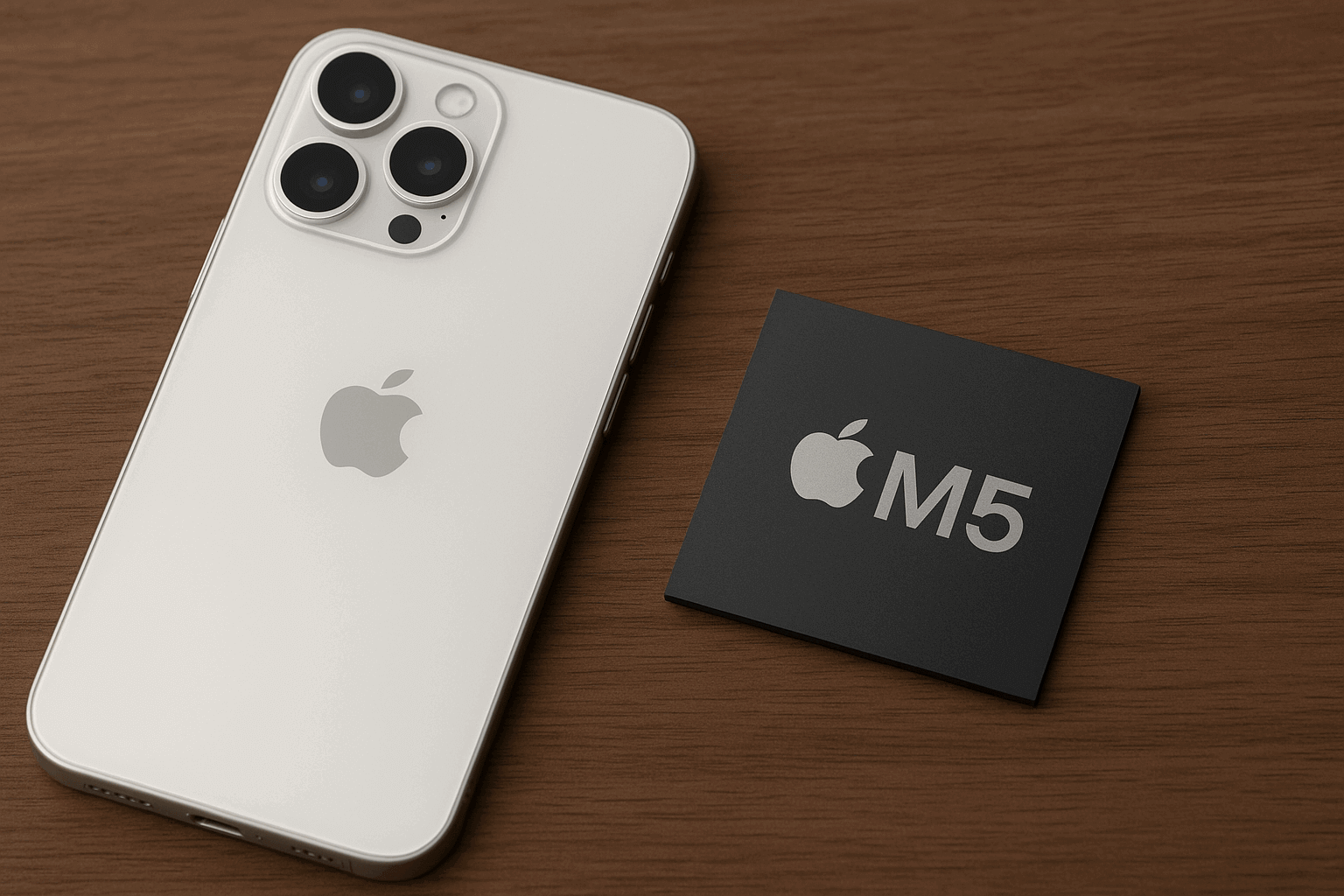
While everyone was watching OpenAI and Google battle it out in the cloud, Apple quietly dropped a bombshell that could change how we think about artificial intelligence forever.
The company’s new M5 chip isn’t just another speed bump. It’s a completely different vision of AI’s future – one that runs in your pocket instead of a distant data centre.
Two Philosophies, One Battle
The AI world has split into two camps, each with radically different ideas about where intelligence should live.
In the cloud corner, you have OpenAI and Google.
Their approach is simple: build massive, incredibly powerful models that live in data centres. When you need AI, your device makes a call to these digital brain warehouses. It’s like having access to a supercomputer, but you’re essentially renting time on someone else’s machine.
Then there’s Apple, taking a completely different path.
The M5 chip represents their bet on edge computing—bringing that AI power directly to your device. No phone calls to the cloud. No subscriptions.
No waiting for an internet connection.
The M5’s Secret Weapon
Apple’s M5 chip features a faster 16-core Neural Engine and Neural Accelerators, specifically designed for on-device AI workloads.
This isn’t just about making things faster—it’s about fundamentally changing where AI processing happens. The numbers tell the story.
The M5 delivers over four times the peak GPU compute performance for AI compared to its predecessor, along with nearly 30% more unified memory bandwidth. But raw power isn’t the real innovation here.
The real game-changer is what this means for how you interact with AI.
Why On-Device Matters
Privacy becomes automatic when your AI never leaves your device.
There’s no server storing your conversations, no company analysing your requests, no data floating around the internet. Apple’s AI philosophy emphasises privacy-first on-device processing, keeping everything local.
Speed gets ridiculous when you eliminate network latency. No waiting for responses from distant servers.
No wondering if your internet connection is fast enough. The AI lives right there with your data, ready to respond instantly.
Cost becomes predictable when you’re not paying per API call. You buy the device once, and the AI works as long as the hardware does. No monthly subscriptions, no usage limits, no surprise bills.
Reliability means your AI works anywhere—on a plane, in a basement, during internet outages.
Intelligence travels with you.
The Maverick Move
Apple’s approach flies in the face of conventional AI wisdom.
While everyone else is building bigger models that require more powerful servers, Apple is building smarter models that can run on the computer in your backpack.
This creates possibilities that cloud AI simply can’t match. Imagine AI that can process your photos without sending them anywhere. Voice assistants that work instantly, even with no signal.
Creative apps that generate content in real-time without any lag.
This on-device approach contrasts sharply with cloud AI strategies that focus on massive, powerful models accessed remotely through API calls that require network connectivity and payment.
What This Means for You
The future of AI isn’t just one giant brain in the cloud. It’s millions of smaller, private, and highly capable brains sitting on our desks, in our pockets, and throughout our daily lives.
This shift will create entirely new categories of applications. Apps that are fast enough to feel magical. Private enough to handle sensitive information. Reliable enough to work anywhere.
We’re not just talking about better Siri responses.
We’re talking about AI that can analyse your entire photo library in seconds without sending a single image to Apple. Video editors that can generate effects in real-time. Writing assistants that know your style intimately but never share your thoughts with anyone.
The Real Race
The battle between cloud and edge AI is about which one fits different needs.
Cloud AI will continue to excel at tasks requiring massive computational power and shared knowledge. Edge AI will dominate scenarios where privacy, speed, and reliability matter most.
Apple’s M5 chip represents a bet that personal AI should be exactly that—personal. Not shared, not rented, not dependent on someone else’s infrastructure.
While you were watching the chatbot wars, Apple was quietly building the foundation for AI that lives with you, not above you in the cloud.
The question isn’t whether this approach will succeed. The question is how quickly the rest of the industry will follow.