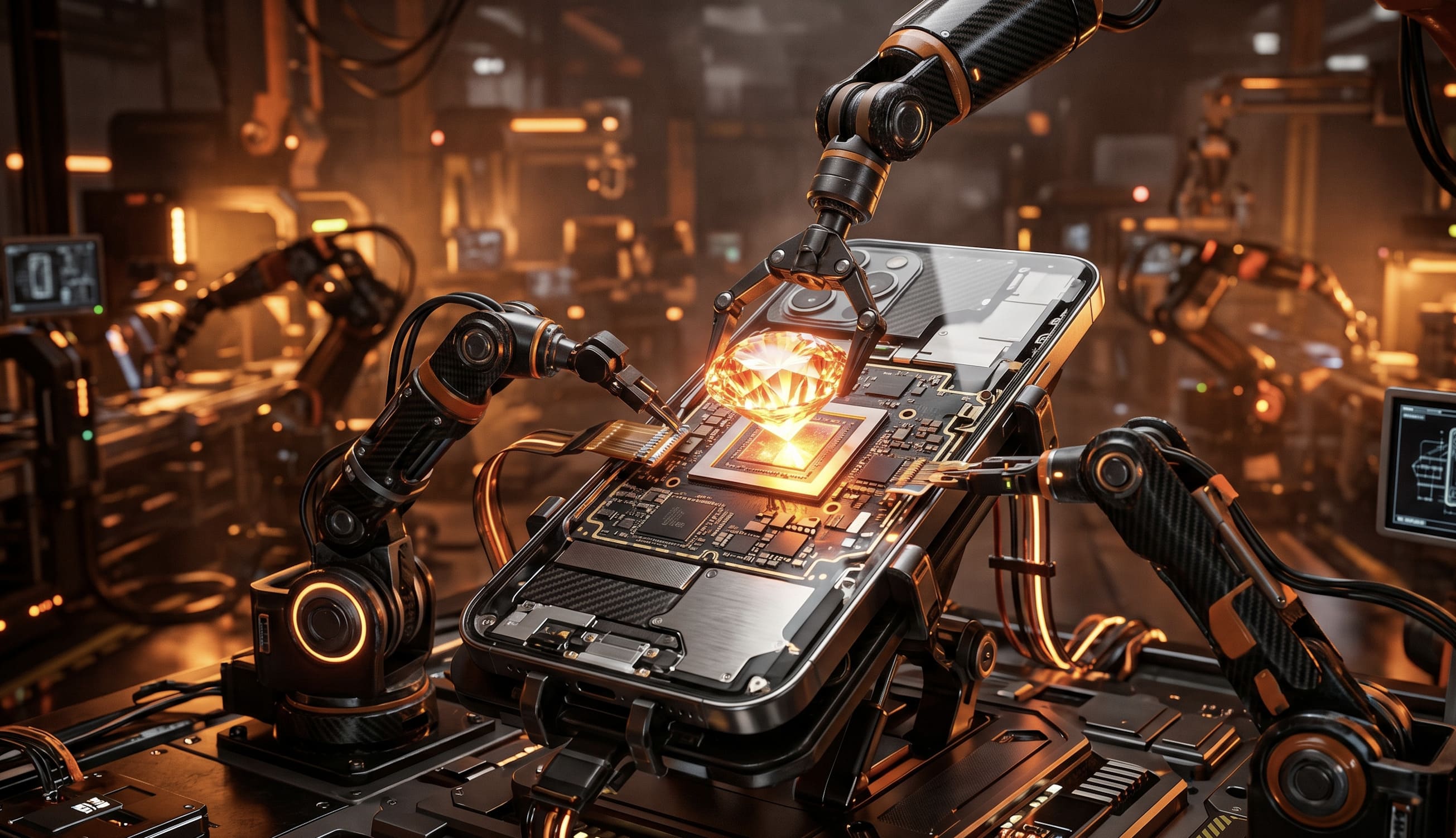
The era of the sub-£80 smartphone may be over. With component economics shifting, entry-level handsets are increasingly considered “permanently uneconomical” to manufacture. A memory chip shortage fuelled by AI data centres is now expected to run through 2027, and consumers will feel it in their wallets long before the fabs catch up.
The AI data-centre effect
Every time a large language model processes a query, it consumes memory — a lot of it. As AI infrastructure scales at speed, data centres are hoovering up DRAM and NAND flash at a pace that was simply not anticipated a few years ago. The result? A global memory chip market stretched well beyond its limits.
Three companies — Samsung, SK Hynix, and Micron — control roughly 90% of the world’s memory supply. All three are racing to build new fabrication plants, but semiconductor fabs are not like warehouses. They take years to plan, licence, construct, and certify. The capacity crunch has a long tail.
What this means for you
The impact is already visible on shop shelves and product listings. Smartphone global shipments are projected to fall 13% in 2026 — a loss of around 160 million units, and the steepest single-year decline in more than a decade. Fewer phones, chasing the same level of demand, pushes prices up.
It is not just smartphones. Laptops, gaming consoles, tablets — anything with significant memory inside is subject to the same supply squeeze. If you have been putting off an upgrade, the calculus may have changed: buying now, at today’s prices, could be cheaper than waiting until market conditions worsen further.
The three companies at the centre of it all
Samsung, SK Hynix, and Micron are investing heavily in next-generation fab capacity, including HBM (high-bandwidth memory) for AI accelerators. But new fabs do not flip a switch and suddenly produce chips. Tooling, calibration, and yield improvement take years. The market is unlikely to feel meaningful relief before 2027 at the earliest — and that is the optimistic scenario.
Smarter AI could ease the pressure
Not all of the news is grim. More efficient AI models could soften demand for memory chips considerably. Google’s TurboQuant technique, for instance, cuts the memory consumption of large language models by a factor of six — with no reported accuracy loss. If compression and quantisation techniques like this become standard practice across the industry, the insatiable appetite of data centres for memory could be reined in, allowing supply to catch up sooner than expected.
The bottom line
The memory chip shortage is not a blip. It is a structural mismatch between where the world’s computing is going — AI-first, data-hungry, always-on — and where semiconductor capacity currently sits. For consumers, that means higher prices, fewer choices, and longer waits for affordable hardware. The advice is simple, if a little counterintuitive: if you need to upgrade, sooner is better than later.